Recycling & processing
Files & data carriersdestroyed securely, recycled cleanly.
 Destroy securely, recycle cleanly
- World
- Recycling
- Technologies
- 8
- Reference projects
- 4
- First project
- 2008
01Typical process chain
The typical route through the plant.
Swipe sideways to see the whole line →
The whole line at a glance
Select a numbered station in the drawing to see details, technology and projects.
Guide value – project-specific design required.
02Challenges
What this material demands of the technology.
Security level
The required particle size determines cutting unit and screen. It follows from the protection class of the data.
Mixed deliveries
Binders, clips, films and data carriers often arrive together. The technology must tolerate or remove metal parts.
Volume & dust
Paper is bulky and dusty. Enclosed conveying, extraction and compaction keep the hall clean.
Traceability
From reception to filling, the material's route should be controlled and documentable.
Typical input material
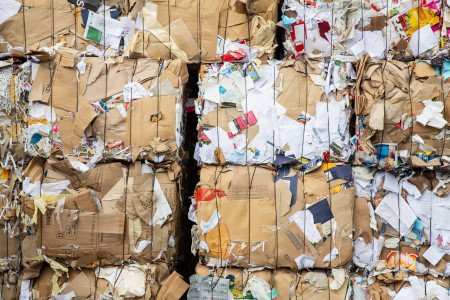
- 01Files and binders
- 02Paper and cardboard
- 03Data carriers
- 04Films and packaging residues
Typical goals
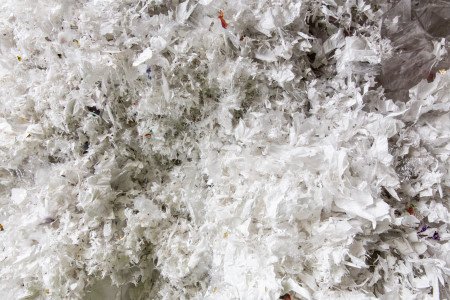
- →Particles of a defined size
- →Bales or filled containers
- →Removed metals
- →Raw material for paper recycling
03Suitable technologies
Technology that suits this material.
 01
01Shred.
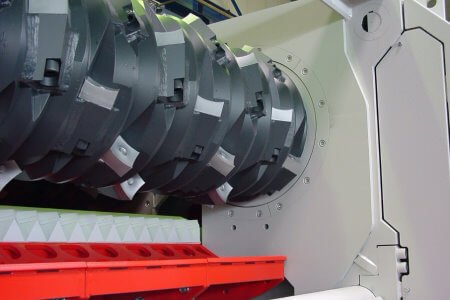
Shredding technology
The heart of every processing line. Single- and multi-shaft shredders, chippers and mills – matched to your material and the particle size the next step needs.
 02
02Convey.
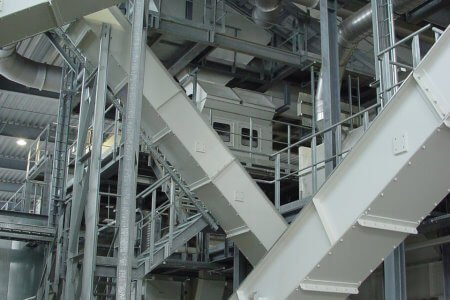
Conveying technology
Belt, chain, screw and vibrating conveyors sized in length, width and capacity to the material flow – turning machines into a plant.
 04
04Separate.
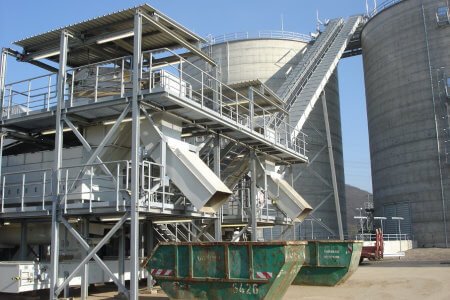
Separation technology
Removing metals, stones and contaminants selectively – for pure, homogeneous fractions of high value.
 05
05Store.
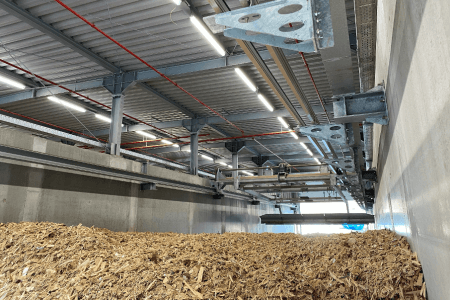
Storage technology
Bunkers, silos and top loaders buffer between processing and consumption – for high availability and smooth operation.
 06
06Dose.
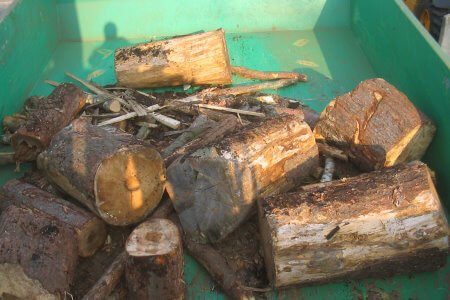
Dosing technology
Discharge by push floor, screw or vibration: a steady, controlled material stream for boiler, press or kiln.
04From our projects
Already built – for this material.
- 2017Large document-destruction plant in East WestphaliaIn the same year, a large document-destruction plant was installed near the residual-wood plant in East Westphalia.Germany · Line & sub-system
- 2016Complete document-destruction plant in LuxembourgVecotrade supplied a customer in Luxembourg with a complete plant for destroying files.Luxembourg · Complete plant
- 2014Document destruction for a gearbox manufacturerVecotrade supplied a large German gearbox manufacturer with a plant in which the company's internal documents and papers are destroyed.Germany · Line & sub-system
- 2008Plant for destroying files and data carriersA client in Germany commissioned Vecotrade to supply and install a plant that destroys files and data carriers.Germany · Line & sub-system
05FAQ
Frequently asked questions
01Which security level can the plant reach?
That depends on the cutting unit and screen size. We design the plant for the protection class your customers require.
02Can data carriers be processed too?
Depending on the type of carrier, yes – often in a separate line or batch. We clarify this based on your material mix.
03How is the destroyed material filled?
Depending on the recycling route, into bales or directly into containers. We plan the filling as part of the plant – with suitable conveying and storage.

Next step
Plan a document destruction plant
Material, volume, goal: the plant planner structures your enquiry in five steps. We will get back to you with an initial technical assessment.